Baobab
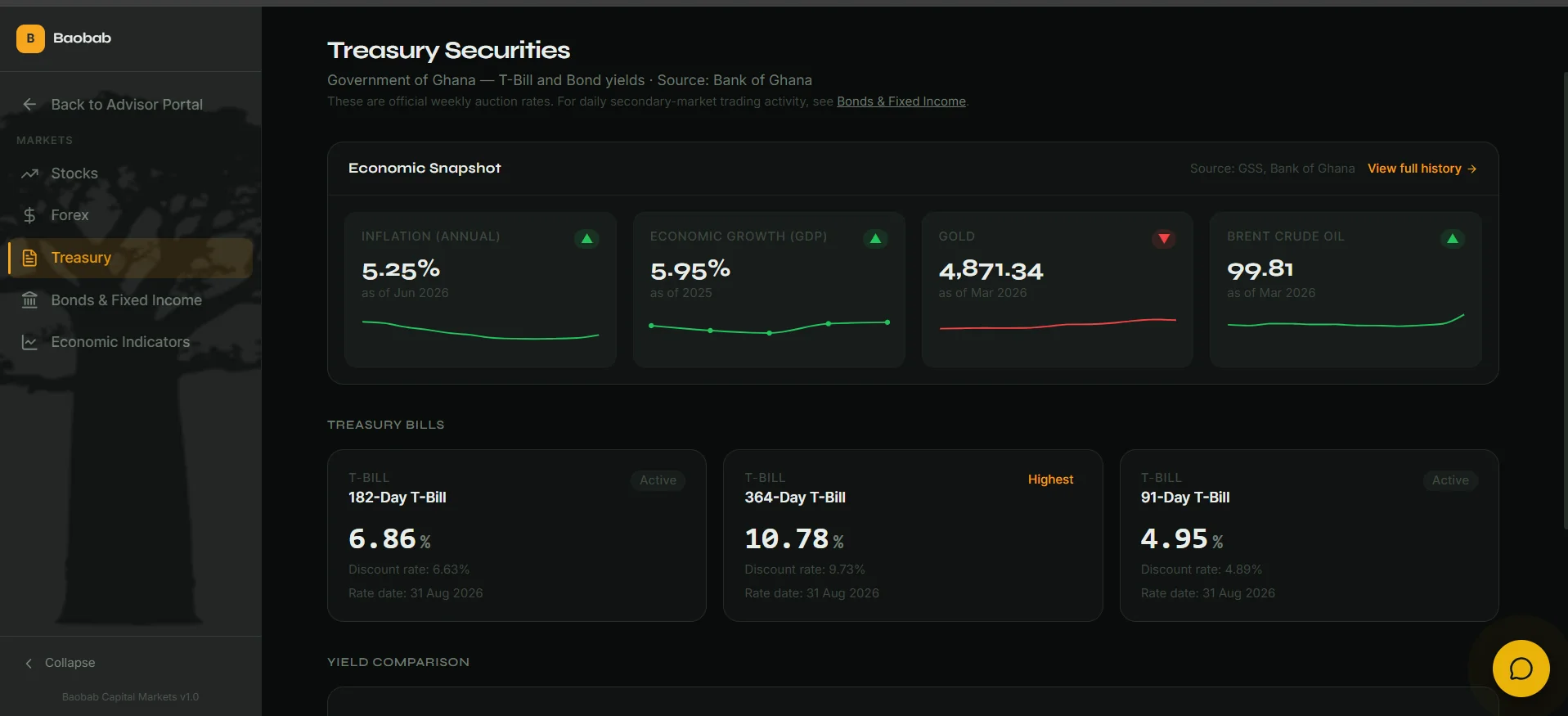
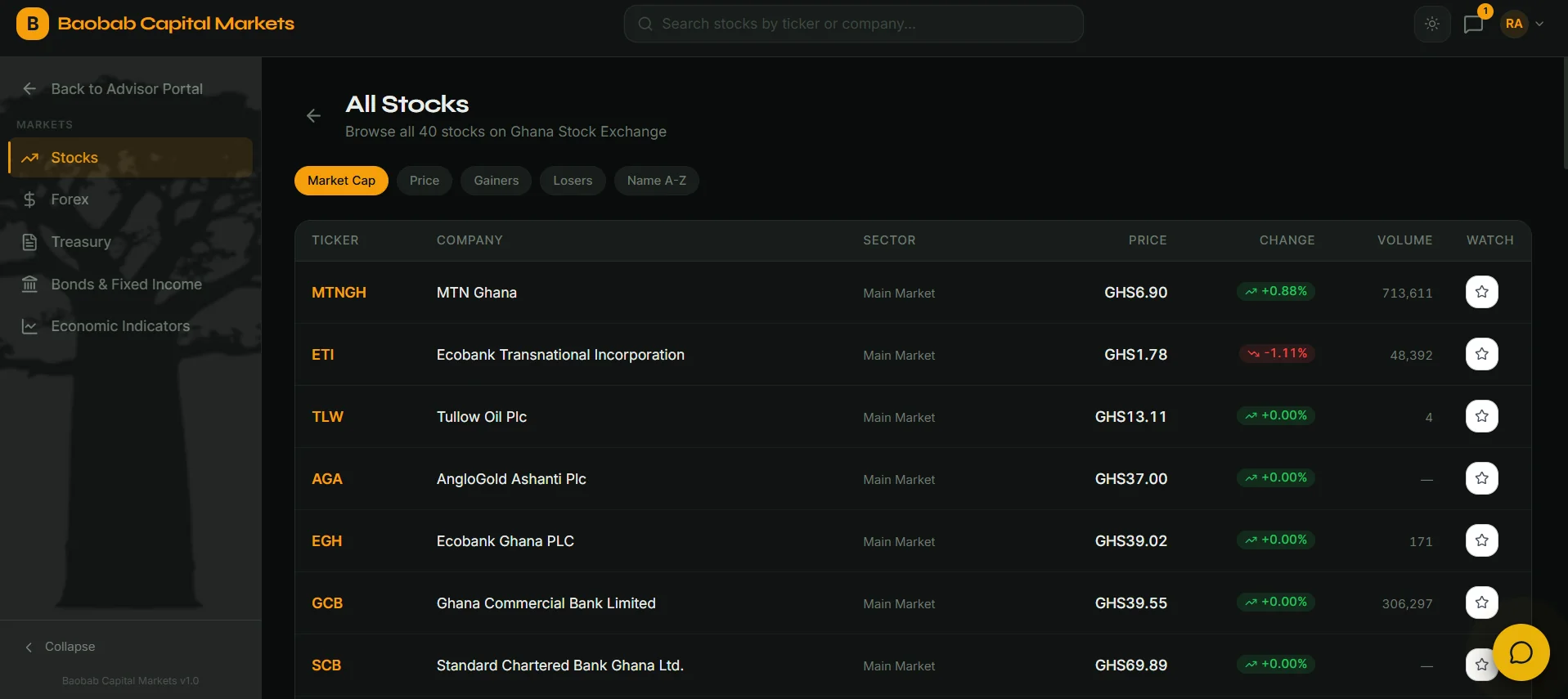
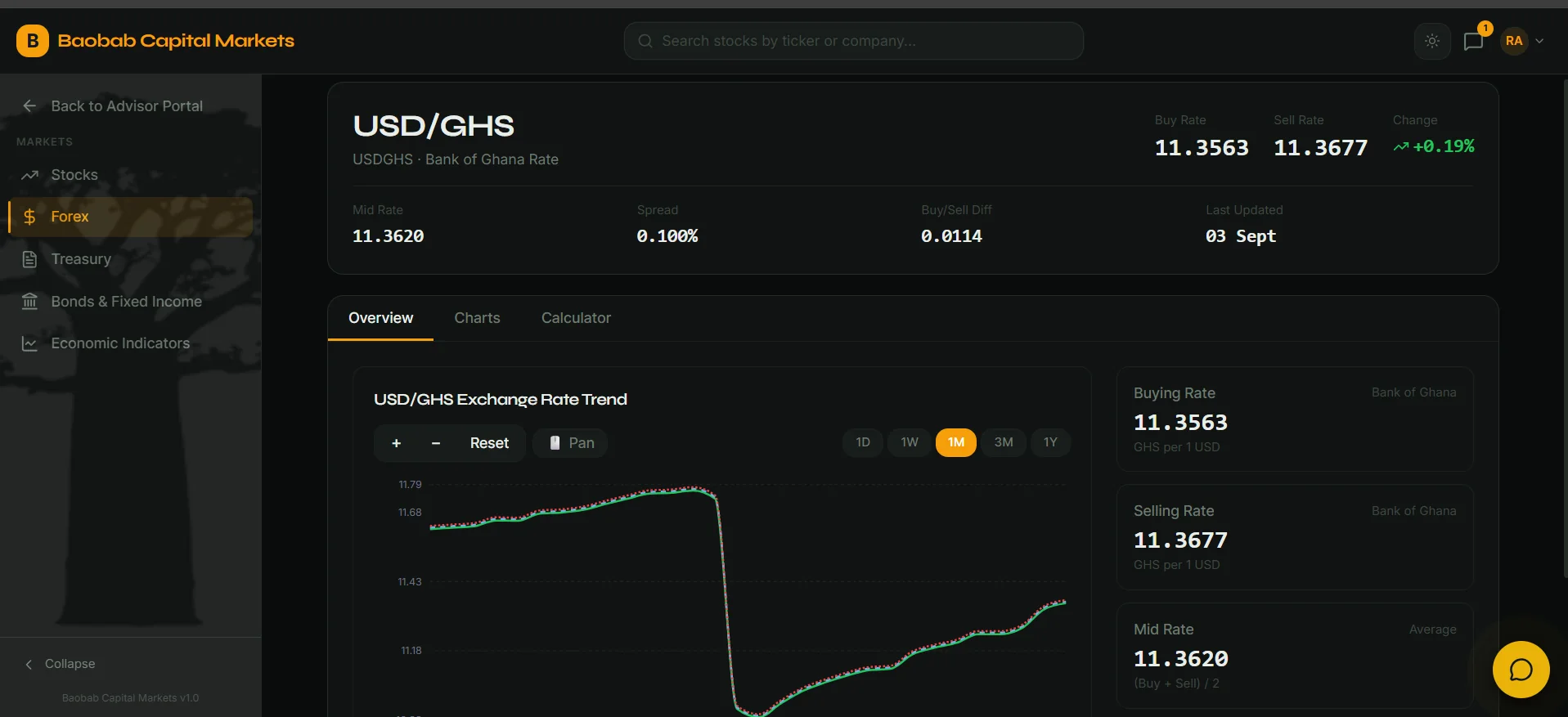
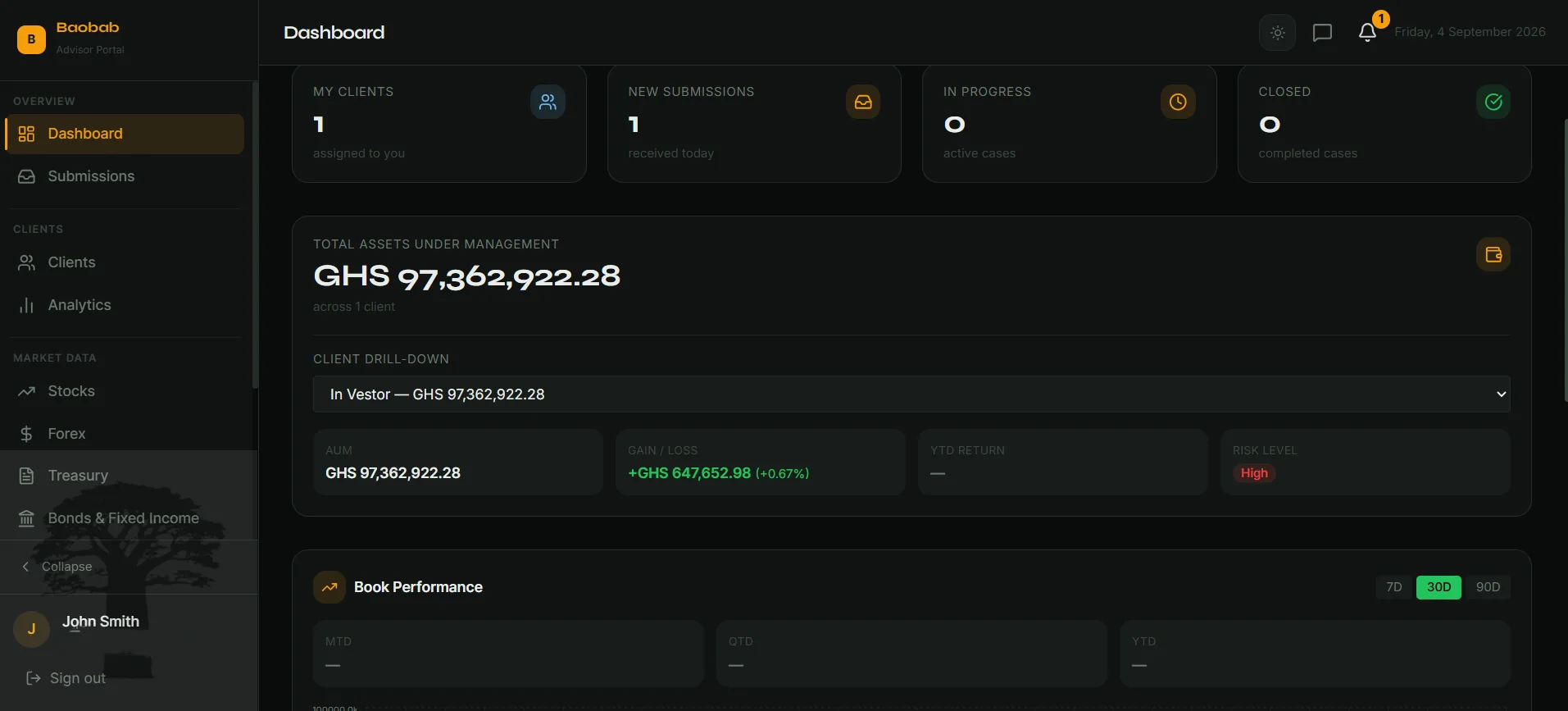
In productionBaobab gives advisors and their clients one terminal for Ghana Stock Exchange equities, Bank of Ghana forex and treasury data, GFIM bond trades, macroeconomic indicators, managed portfolios, and an AI assistant. Before it, that meant a spreadsheet a client kept by hand and whatever an advisor could look up separately.
- Role
- Sole engineer, first commit to production
- Period
- Oct 2025 to Aug 2026
- Status note
- In production and in active use at KAN Asset Management.
The problem
A wealth manager's advisors were valuing client portfolios by hand: a spreadsheet per client, prices copied in from wherever an advisor happened to look that morning, and a macro picture assembled separately for every conversation. Nothing was live, nothing was shared, and nothing forced a stock quote and a treasury rate to agree on what day they were from.
The brief was a single terminal: Ghana Stock Exchange equities, Bank of Ghana forex and treasury instruments, GFIM secondary bond trades, the standard macro indicators, and portfolios that revalue themselves against those prices instead of being re-typed.
The constraint
There is no single API for the Ghanaian capital markets. Four separate institutions publish data in their own formats and on their own schedules: a nightly CSV export, scraped tables, an Excel workbook, PDF bulletins, and, for live equity prices, a free third-party API with no service guarantee. Building the terminal meant building the data supply chain underneath it first, with no vendor to blame when a source changed shape.
It also had to be built and operated by one person, in production, with real client money represented on screen. There was no second engineer to catch a bad migration or a silent ingestion failure before it reached an advisor.
Architecture
The backend is FastAPI over SQLAlchemy and PostgreSQL 17, organised into domain services sitting behind 20 router modules. Celery workers, backed by Redis, run the ingestion pipelines and the scheduled jobs on queues kept deliberately separate: a data_collection queue for scraping and parsing, and a separate queue for anything the API itself triggers, so a slow scrape never blocks a user request.
The frontend is a Next.js 14 App Router terminal: Zustand for client state, SWR for data fetching, Recharts for the charts advisors actually read numbers off, Framer Motion used sparingly. Auth is JWT with refresh tokens, bcrypt for storage, and role-based access control between advisors and their clients.
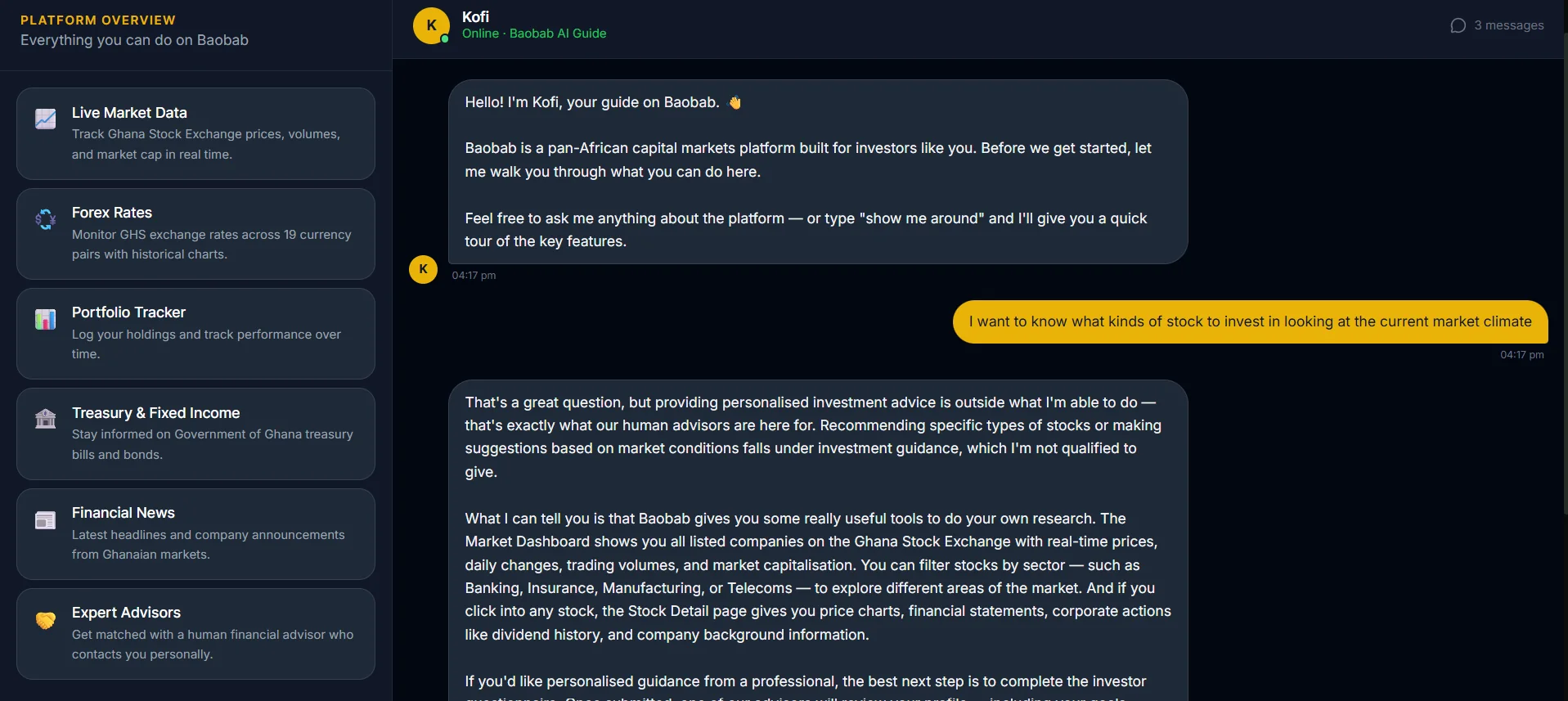
Kofi, the platform's assistant, is a retrieval-augmented generation service: sentence-transformers embeds a small internal knowledge base into pgvector, the Anthropic Claude API generates the answer, and the retrieval step is scoped to platform and FAQ content only, never client portfolio data.
How the data layer ingests a market
Decisions, and what they cost
Six ingestion pipelines instead of one abstraction
Each of the four publishing institutions gets its own pipeline, and GSE and Bank of Ghana each need two, because their data types don't share a shape. The cost is six things to maintain instead of one clever adapter. The alternative, a single generic ingestion abstraction, would have meant bending an Excel bond-trade parser and a PDF inflation-report parser into the same interface for no reason except that both eventually become a row in Postgres. Building six honest pipelines was the less clever and more correct choice.
A gap-detection orchestrator instead of trusting the schedule
A single 8 PM UTC orchestrator scans the last 90 business days in Postgres for missing dates per data type before it dispatches anything, and caches the result in Redis with a two-hour TTL, deliberately shorter than the run interval so a stale cache can't hide a real gap for long. This exists because a nightly cron job that assumes it ran successfully last night is the single most common way market data goes silently stale. A Sunday 2 AM subprocess backfill covers gaps that fall outside the daily CSV window.
The scraping worker itself runs at Celery concurrency 1. Multiple concurrent Playwright browser instances contending for the same upstream page produced enough flakiness that trading it for slower, serial, reliable scraping was the right call.
One canonical price-resolution function
_resolve_holding_price is the single function both the advisor UI and the external partner endpoint call to price a holding, deliberately shared so the two surfaces cannot disagree about what a stock is worth. When a live price is unavailable it returns null rather than falling back to a stale or estimated number: callers have to surface the gap to the user instead of quietly inventing a price. That is a slower failure mode for the UI to handle, and the correct one for a system representing client money.
A system-prompt guardrail for Kofi, and a plan to replace it
Kofi's current guardrail against off-scope questions is a system prompt: an enumerated set of prohibitions and a scripted redirect to a human advisor. That is not a hard boundary, it is a strongly worded instruction, and the honest next step is a classifier with a deterministic refusal path in front of generation. The mitigating fact is that Kofi's knowledge base holds no client data, only platform and FAQ documents, so there is no cross-client retrieval risk even if the guardrail is talked around.
What didn't work
The upstream price API silently drops AWS connections
The GSE price API doesn't error when called from an AWS IP range, it hangs, so the Celery task fetching stock prices simply timed out and stock data went stale with no exception anywhere to alert on.
The first fix was the one that could ship within a day. The API answers browsers from any origin, so live price synchronisation moved to the client: requests came from real user browsers instead of a datacentre, and prices were flowing again. That only works while someone has the app open, though, so the next three days went into getting the server its data back by engineering around the block. A Cloudflare Worker acting as an authenticated proxy came first, on the assumption the block was on AWS's address range rather than on the requester; Cloudflare's edge addresses were refused too. A scheduled GitHub Actions workflow came next, fetching from a runner outside AWS and posting the prices to a sync endpoint. That did not hold either.
What closed it was a conversation: contacting the provider directly, explaining what was being built and how the feed was being used, and they whitelisted the server's address. Server-side fetching became the primary path again, with the browser relay kept as a fallback. A proxy or a relay is a more expensive way to get refused when a block is deliberate, and sending an email was the cheaper, more durable fix, reached for last rather than first. Building the fix also surfaced a second problem, a nightly snapshot job that had been failing silently behind the same block and nobody had noticed. One outage during this period produced 19 failure emails in a morning before a 30-minute cooldown was added to the alerting.
A missing ownership check, found in already-merged code
Two endpoints called the valuation service with no check that the requesting user actually owned the portfolio being valued, so any authenticated user could read any portfolio by incrementing an integer ID. Ron found this himself, after it had already shipped, by re-reading his own code rather than through a report or a scan. The fix returns 404 rather than 403 on an unauthorised request, specifically so a probing attacker can't use the response code to enumerate which portfolio IDs exist.
Behind that sat a second, deeper bug: portfolios.user_id had no foreign key constraint and a default of 1, so any insert that omitted a user_id silently attributed the portfolio to user 1 instead of failing. The fix added the foreign key and a NOT NULL constraint, dropped the default, and removed four service-function parameter defaults of = 1 that had been quietly relying on it. It shipped behind a read-only preflight script and an atomic, idempotent migration, because a migration that touches ownership on financial records in production does not get a second, casual attempt.
More
What the terminal ingests
Four publishing institutions, six independent pipelines, each with its own parser and its own way of avoiding duplicate writes when a job reruns: file-level tracking tables for repeating publications, a UNIQUE(url) constraint for news articles, upserts everywhere else.
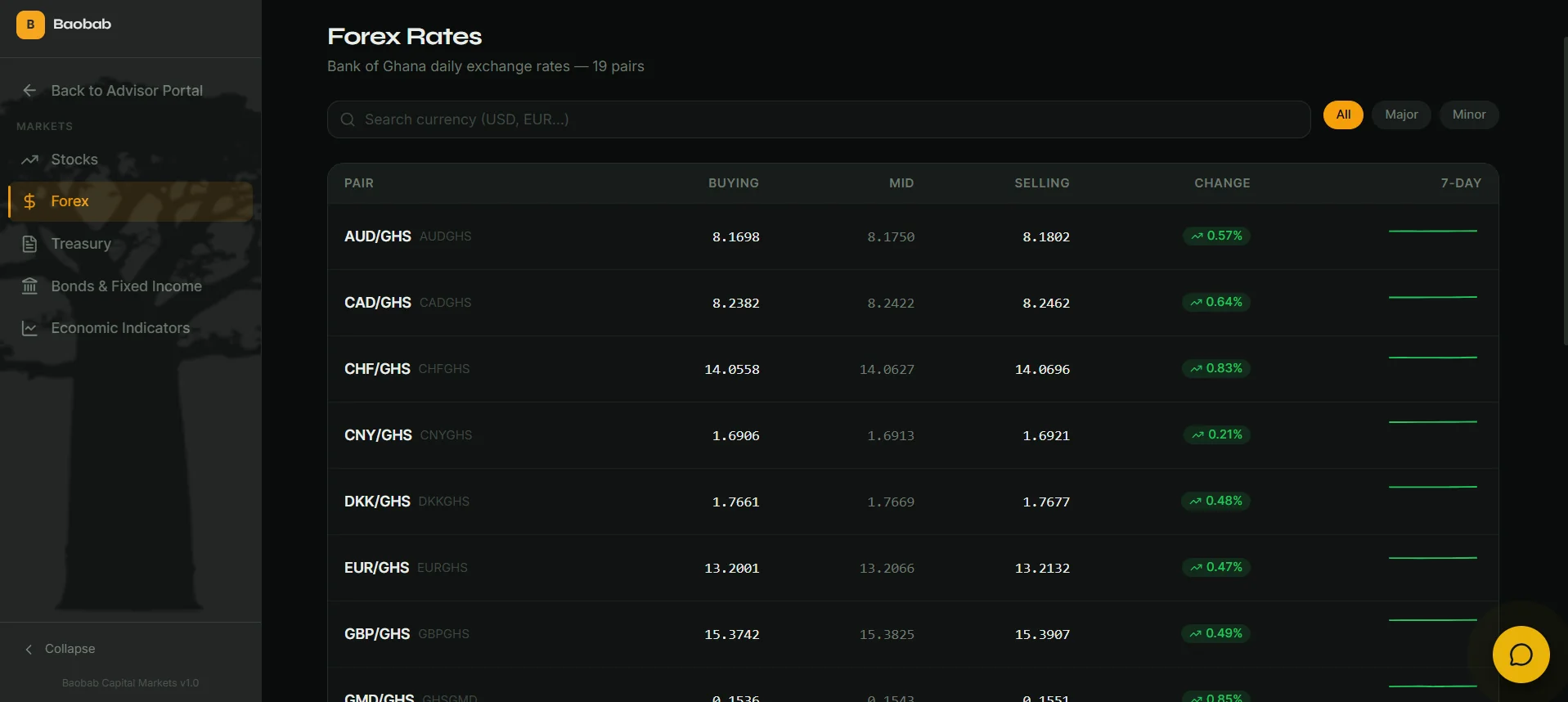
GSE listed equities come from the Kwayisi API live during market hours, with Playwright and Scrapy used for historical backfill, polled every 5 minutes. Bank of Ghana forex, 19 currency pairs, and Bank of Ghana T-bills and bonds both arrive nightly at 8 PM, the forex as a CSV export and the rates scraped. GFIM secondary bond trades are parsed nightly from an Excel export. Ghana Statistical Service CPI and GDP, and the Bank of Ghana bulletin's cocoa, gold, and Brent crude figures, are parsed from PDFs on the 5th of each month. Ghana business news arrives hourly over RSS.
There is no holiday calendar in the scheduling, only weekend exclusion, so a public holiday during market hours is treated as a normal trading day until proven otherwise by the gap detector.
The numbers
- commits on the platform
- 170 of 182Counted. git log
- backend Python files
- 214Counted. repository, backend/
- source files created or modified
- ~545Counted. git log --diff-filter, full history
- API route declarations
- 138Counted. 20 router modules
- SQLAlchemy models
- 21Counted. backend/app/models
- domain services
- 14Counted. backend/app/services
- SQL migrations
- 19Counted. alembic/versions
- routed Next.js pages
- 31Counted. frontend/app
- frontend TypeScript files
- 155Counted. frontend/
- test files
- 35Counted. 32 pytest, 3 Jest
- Kofi retrieval accuracy
- 16 of 17Measured. manual retrieval evaluation set
The only other contributor made 12.
sentence-transformers all-MiniLM-L6-v2, 384 dimensions, pgvector cosine distance, top_k 3.
Screenshots
Stack
- Next.js 14 (App Router)
- TypeScript
- Tailwind CSS
- Framer Motion
- Recharts
- Zustand
- SWR
- FastAPI
- SQLAlchemy
- Pydantic
- PostgreSQL 17
- Celery
- Redis
- Anthropic Claude API
- pgvector
- sentence-transformers
- Playwright
- BeautifulSoup
- Scrapy
- JWT with refresh tokens
- bcrypt
- AWS EC2
- Cloudflare Workers
- Nginx
- GitHub Actions
- NSSM / systemd